

June 1, 2026
The Office That Breathes: Sustainability in Workplace Design
By Gareth Barton
June 1, 2026
By Gareth Barton
Today, the best sustainable workplaces are something far more ambitious. They are spaces that consume less, waste less, and support wellbeing at the same time. They feel healthier, calmer, and more connected to the natural world.
I often ask clients a simple question at the start of a project: does your office breathe?
Not literally, though some ventilation strategies certainly need help. What I mean is this: does the space feel connected to daylight, airflow, natural materials, and human comfort? Or does it feel sealed, artificial, and permanently switched on?
The future sustainable office is less like a machine and more like an ecosystem.
For years, workplace design prioritised density and efficiency above all else. More desks, more people, less space. The result was often offices heavily dependent on artificial lighting, mechanical cooling, and synthetic materials simply to remain comfortable.
That approach is changing.
The most effective sustainable workplaces now combine ecology, efficiency, and adaptability. Materials play a major role. Reclaimed timber, recycled finishes, natural fibres, and responsibly sourced furniture reduce embodied carbon while creating spaces that feel warmer and more tactile. Sustainable offices should not feel clinical. They should feel grounded.
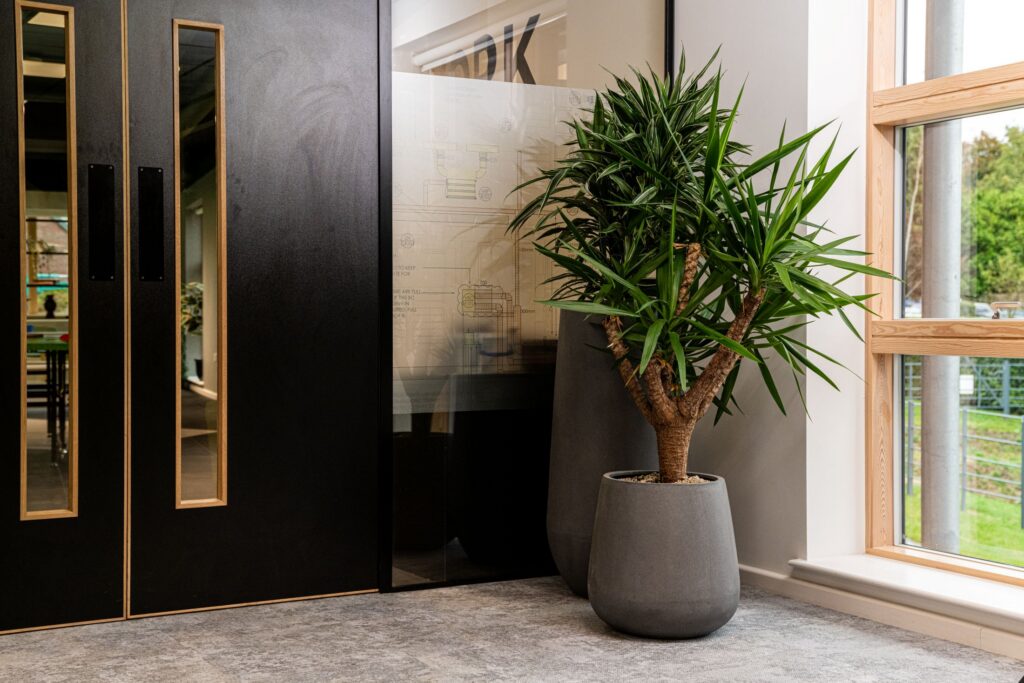
Air quality matters too. Offices that incorporate natural ventilation, planting, and better airflow tend to improve comfort while reducing reliance on mechanical systems. People function better in spaces that feel alive.
Lighting is another overlooked opportunity. Some offices are still illuminated like airport terminals regardless of occupancy or daylight levels. Maximising natural light and using intelligent lighting systems reduces energy demand while also improving mood and focus.
Flexibility may be the most important sustainability strategy of all. The greenest office is often the one that does not need rebuilding every five years. Adaptable layouts, modular furniture, and reusable materials allow workplaces to evolve rather than become obsolete.
When clients ask for practical ways to create a sustainable office, the advice is usually straightforward:
use less, waste less, design for longevity, and create spaces people genuinely value.
The strongest workplaces tend to share the same qualities. They breathe naturally, adapt easily, and connect people to light, texture, and ecology rather than separating them from it.
Sustainability is no longer just a specification target. It is a design philosophy about how offices coexist with both people and planet.
And increasingly, the workplaces that perform best environmentally are also the ones where people feel best within them.
If you’d like to explore our how we can support your office design journey, in the most sustainable way possible, get in touch to chat through your priorities.
If you’d like to explore our how we can support your office design journey, in the most sustainable way possible, get in touch to chat through your priorities.
Contact us